● Case study · Product landing
Companionlyy
The front door for a companion-matching service for older adults. Two audiences, families and helpers, each with a clear path from the first screen.
Visit companionlyy.com ↗- Stack
- Next.js + Tailwind
- Hosting
- Vercel
- Structure
- 11 routes
- Full load
- 1.3 s
Measured on a single desktop load, November 2026.
01 — The brief
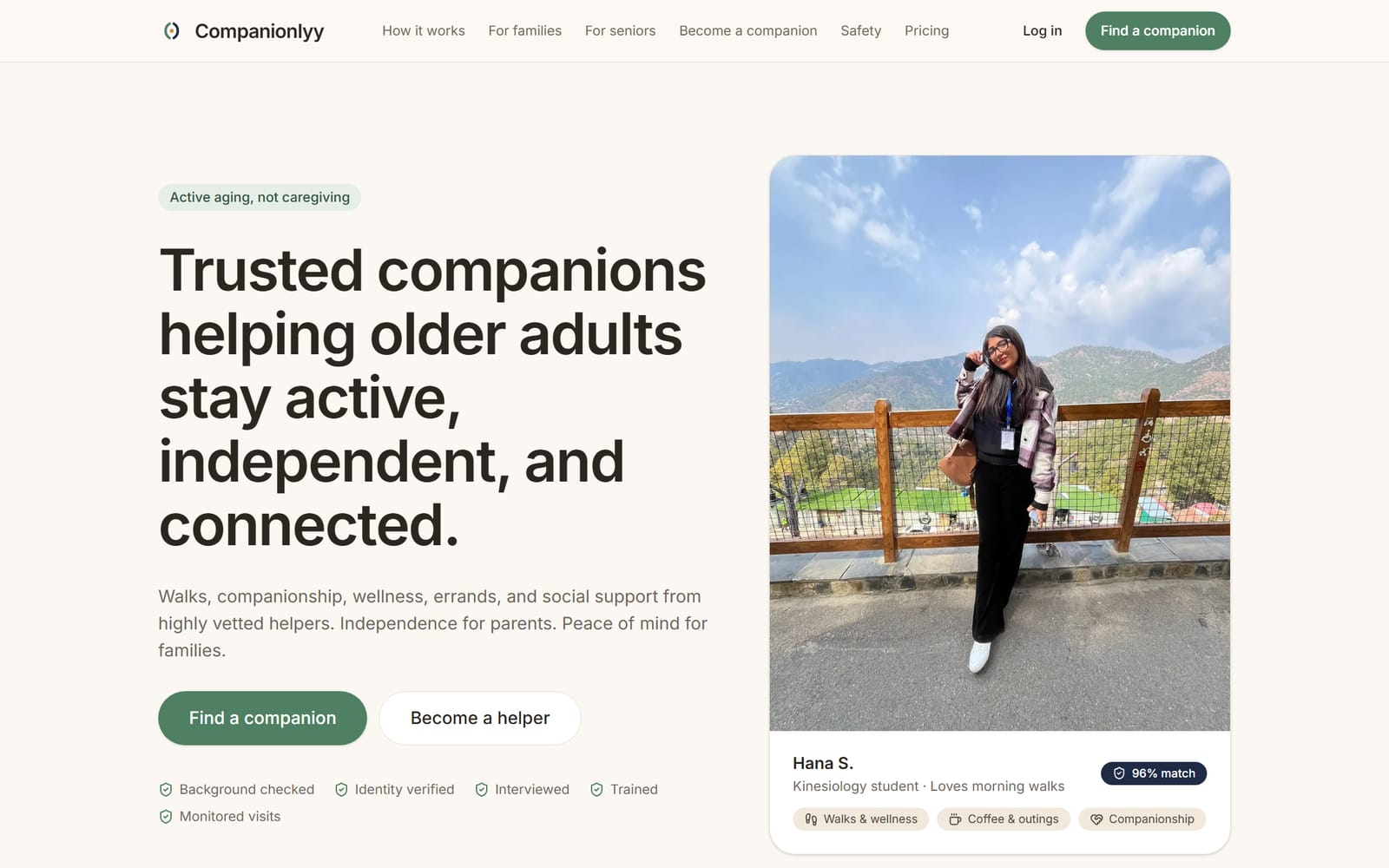
Companionlyy matches older adults with vetted companions for walks, errands and company. It is not caregiving, and the site has to make that distinction clear straight away.
It also serves two different visitors. An adult child worried about a parent needs reassurance. A student who wants to become a helper needs to know what the work involves. Both have to find their path from the same first screen.
02 — What we built
Two doors on the first screen
“Find a companion” and “Become a helper” sit side by side in the hero, each leading into its own set of pages.
Trust shown, not claimed
Background checks, identity verification, interviews, training and monitored visits are listed up front, with a dedicated safety page behind them.
The product, previewed
A companion profile card with interests and a match score shows what using the service looks like before anyone signs up.
A full marketing site
Separate pages for families, seniors, helpers, pricing, safety, FAQ and contact, plus sign-up and log-in.
03 — Under the hood
- 01
Server-rendered pages
Built on the Next.js App Router, so the content arrives in the first response and is readable by search engines without waiting on scripts.
- 02
Optimised images and fonts
Photos go through the Next.js image pipeline and Inter is self-hosted, which avoids layout jumps while the page loads.
- 03
Light on the wire
On our test load the homepage transferred 136 kB across 13 requests, answered in 226 ms and finished loading in 1.3 seconds.
Next project
Leena's Studio NYC →